
It’s easy to take standing steady for granted – until it becomes difficult
Orthostatic Tremor (OT)
NEWS: Global OT Survey

The survey examines the experiences of people living with orthostatic tremor—including aspects such as diagnosis, symptoms, treatment, and the impact on daily life. Participation is possible in several languages. Access the survey here: https://www.surveymonkey.com/r/WR8567Z
or find more information here:
Global Orthostatic Tremor Survey 2026 – Orthostatic Tremor UK Support Group

Understanding Orthostatic Tremor
Orthostatic tremor (OT) is a rare neurological movement disorder characterized by rapid muscle contractions at a high frequency (13-18 Hz) in the legs and sometimes the torso when standing. OT is also responding to muscle load in non-orthostatic positions.
In fact, the muscle’s activity resembles the sound of a helicopter, a typical sign of Orthostatic Tremor.
People with OT may not see or sense that their legs are having rapid muscle contractions; it may just feel like unsteadiness, or a loss of balance. The tremors typically aren’t painful while they’re happening, but affected individuals may develop leg muscle pain and stiffness over time.
Going from standing to sitting, walking, or leaning against a wall usually stops or greatly reduces the tremors.
What can you do if you suspect that you might have OT?
Ask your physician to place a stethoscope just a little to the outside of the thigh or slightly on the outer side of the calf. In case of OT you can hear the helicopter sound.
Another way to identify the tremor is with smartphone apps using the accelerometer feature.
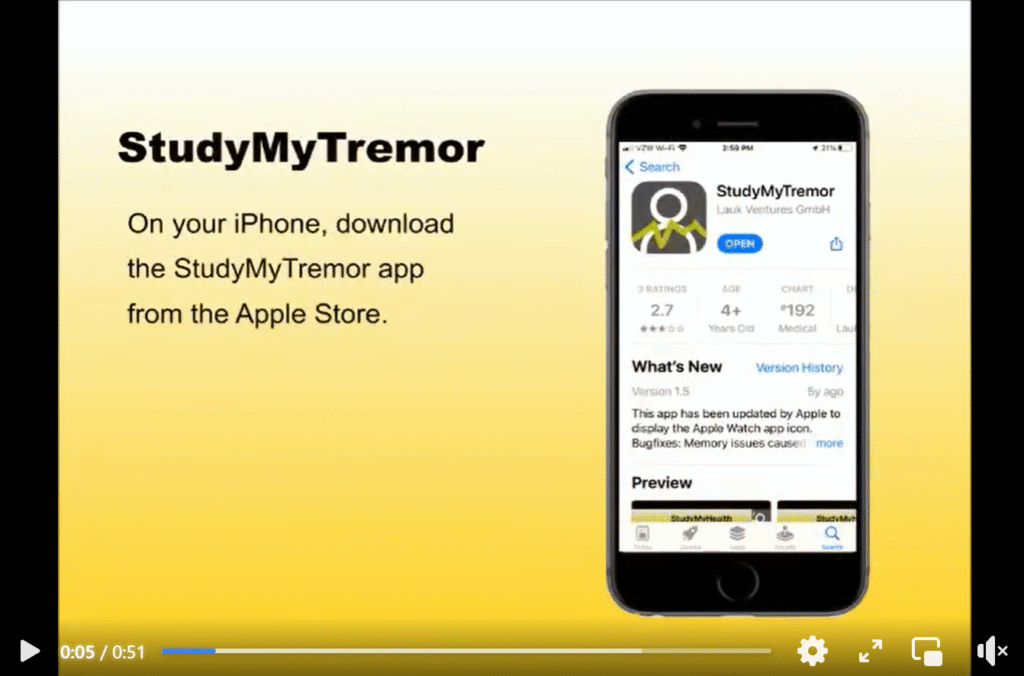
Find here a video by Dave Teffeteller showing how to use the iPhone app StudyMyTremor to quickly determin the frequency of the orthostatic tremors. Although the app was created for those with hand tremor it can be use to measure OT tremors as well. There are similar app as well.
The diagnosis can be confirmed by assessing the electrical activity in the leg muscles with a surface electromyography (EMG) while standing.
You may have to advocate for yourself, but getting the right diagnosis is worth it!
More information
https://www.orthostatictremor.org/
Cleveland Clinic:
Orthostatic Tremor: What It Is, Causes & Treatment
I care for your brain with Dr. Sullivan – Youtube:
Orthostatic Tremor
Orthostatic Tremor & Gait
***
Selection of research articles and papers:
Aug 2025: “Orthostatic Tremor is evoked by muscle load without need for orthostatic position” by Karolina af Edholm MD, Gonzalo Uribarri PhD, Mathias Sundgren MD, PhD, Anders Svenningsson MD, PhD, Erik Fransén PhD
June 2025: “Beta-Alanine Relieves Symptoms in Primary Orthostatic Tremor” by Karolina af Edholm in Movement Disorders Journal
PhD thesis, 2023: “The gait disorder in patients with orthostatic tremor – Manifestation, modulation, and strategies for therapy” by Ken Moehwald
PhD thesis, 2021: “Orthostatischer Tremor:
Epidemiologie, Langzeitverlauf und Diagnostik” by Flavia Guri

Disclaimer
The information provided on this website is for general informational purposes only and is not intended as, nor should it be considered a substitute for, professional medical advice, diagnosis, or treatment. The creator of this website is not a medical professional or healthcare provider. Always seek the advice of your physician or other qualified health provider with any questions you may have regarding a medical condition. Never disregard professional medical advice or delay in seeking it because of something you have read on this website.